
Fair warning: This piece includes some language from the trading floor.
I cannot recommend more highly that you watch the movie “The Big Short.” It’s become one of my all-time favorites, for two reasons:
- I spent 20 years in the investment world, and this movie realistically portrays many aspects of Wall Street;
- Buried inside the movie is a scene that should be studied by everyone who buys anything, or who hopes to sell anything to anyone.
A bit of background: You might think that Wall Street types are refined, judging by their thousand-dollar suits and $100 lunches. Most times, you would be wrong.
Some of the crudest language I’ve ever encountered in my life was uttered by Wall Street executives, sometimes in elevators in front of strangers. I still shake my head 30 years later. By that measure, this movie is innocent.
To set you up to understand what the scene is about: Vinnie (in the image above) is a trader on Wall Street. He has been directed by his boss to buy some securities because the boss thinks—rightly so, it turns out—that the American financial system in 2009 is on the verge of collapse.
This investment is the absolute opposite of what the big banks and other “experts” said should be done. After the boss orders Vinnie to make the multi-million-dollar trade—and before he’s comfortable doing it—he has just one question for the salesman, Jared. Here’s the scene:
Watch this scene more than once to get everything out of it. Then make sure you watch the full movie.
I’ve watched this movie multiple times, and get something new out of it each time. After those 20 years dealing with Wall Street, I can attest to the raw honesty of this movie. And I can’t think of a scene that includes as many profound dynamics as that short one does.
Yes, the movie is about Wall Street, and it relates to hundreds of billions of dollars. Never mind that. Instead, let’s extract the principles that also apply to small transactions of all types, measured in thousands or even just hundreds of dollars.
Here’s the Problem
Every day, without exception, we visit sites that are long on promises and hyperbole and short on realism. You know the sort of sites I’m talking about:
“When you get our system for selling on Amazon, your bank account will literally explode…”
“How you can make $1,400 a day with my weird trick…”
“You’ll discover powerful secrets the bankers don’t want you to know…”
When you read such garbage, I hope your B.S. sensor lights up because that’s exactly what you are hearing. Why is it B.S.? Because most marketers think the more they hype their product, the more you—the dimwit prospect—will buy.
Therefore, if they could say “you’ll make more money with our Acme Widget”, they’ll instead say:
“Just wait until you see how your bank account will burst at the seams with the money that’ll be pouring in, once you try our Acme Widget.”
“This is the most insane way to make money that I’ve ever seen.”
“The world has changed. The old ways of making money are DEAD. This is the new way…”
You then are shown a product or service that sounds great. At first glance, it seems like everything you’ve been wanting, and then some.
What’s your first reaction? Naturally, it’s enthusiasm, followed two milliseconds later by skepticism. After all, you’ve been disappointed so many times before. If you stop to think about it, almost nothing has ever measured up to the original marketing hype. So why should this time be any different?
Don’t Make Me Hunt
Your reaction means one thing: After you’ve heard all the good stuff, it becomes your job to ferret out the bad stuff. The burden is on you to go into hunting mode: If you’re intrigued and don’t throw the offer in the garbage, you wonder how this opportunity is less than meets the eye. It’s like the shell game con artists play on the streets: your job is to find what they’re hiding and their job is to hide it from you, while taking your money.
This is where the movie is so spot-on: Vinnie gets it. He likes what he sees, and is evaluating the opportunity, but he wants to understand one thing:
What’s in it for the other side?
How does this add up?
The wrong answer: “We’re not fucking you.”
The right answer: “Here’s why we want to do this deal. Here’s exactly what we get from the deal. Here’s how we make loads of money. Here’s why the whole world has not jumped on this opportunity. And here’s why it is STILL a good deal for you despite all the money we’ll make.”
It Has To Add Up
The deal has to make sense. It has to pencil out for both sides. People who don’t understand transactions the way Wall Street veterans do, have this vision of how it works: They think they can fast-screw the other guy and make a fortune before the other person wakes up from a drunken fog and realizes what happened. I mean, how dumb do you have to be to believe that there are “weird secrets” and “bursting bank accounts”? The truth is that good deals get done when both sides have a clear, sober idea of how each side benefits. In fact, they’re OK with that because both sides stand to benefit.
You already have an innate sense of balance: of what something costs and what it can deliver. True story: I once was walking across the street in Boston to get a cup of coffee. I heard “Hey Buddy! Could you use some great speakers?” I turned around, and a guy had the doors to his van open with some speakers in the back. “These babies retail for more than $700 apiece, but you can have them for $50, OK?”
Does that add up for anyone? Even the person who shrugs and accepts that deal knows it makes no sense and the goods must be stolen. Maybe he concludes that it’s somebody else’s problem and buys them.
When some people look to buy a product or service, they first search for the truth about how something works.
Take web hosting. Let’s say I want a host for my site, and I see $49/month offers…$99/month offers…and then $2.95/month for “UNLIMITED HOSTING!!!!!” How can this be? How can these glowing reviews be real, and how can I get everything for less than a Starbucks a month, when those other companies want a hundred bucks a month? Don’t they track their competition?
The intelligent Vinnie would instantly be suspicious. This does not add up. What gives? If he called the $2.95 hosting company and asked how they were fucking him, he’d get silence, followed by a supervisor on the line. Vinnie can’t ask the very question that he really wants an answer to. He’s on his own.
How does $2.95/month hosting add up? What they don’t tell you is your website will be sardined onto one server with 200 other sites. Your site will be slow and subject to how much traffic the other sites in your cesspool are receiving on the same server you now all wallow in. Whose fault is it that you didn’t read the 50 pages of tiny legal print?
At this point, it’s crucial to point out that you need to understand your customer base: are they Vinnies, who are intelligent and want to understand why an especially good deal can work for everyone? Or are they Frankies, who are bottom fishers and greedy idiots?
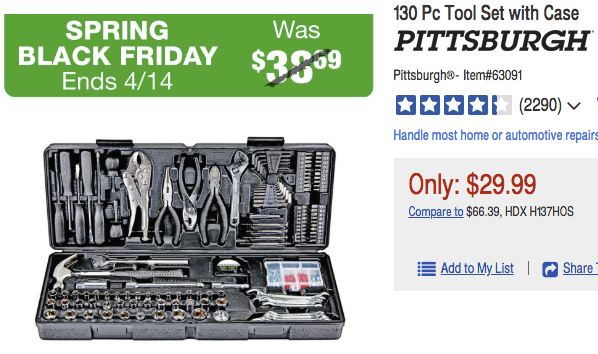
Who’s Frankie? He shops at Harbor Freight, which is a discount tool store. His mantra is: “Why pay more? It’s my fuckin’ hard-earned money.” Frankie recently picked up a kick-ass deal—130 tools for only $29.99!!!! I kid you not!!!! Score!!!! With 2,290 reviews!!!
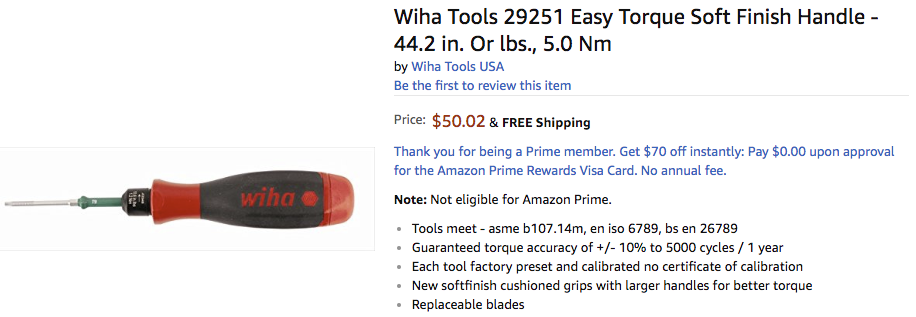
On that very same day, Vinnie also went shopping. He found the 50-dollar screwdriver he was looking for:
Who Is The Idiot Here?
Let’s see: Vinnie bought ONE screwdriver for $50, and Frankie scored 130 tools for $29.99. You may guess that I think Vinnie’s the smart one, by buying solid German-made craftsmanship in that $50 tool. And I probably will conclude that, except it all depends on what Frankie’s objectives are: If he wants a set of tools to last him a lifetime, well uh, I’m not sure he made a shrewd deal at Harbor Freight. But if Frankie wants to give the set to a pack of Cub Scouts to abuse the tools while learning a few skills—that is, in fact, a smart choice. It has to add up.
The Real Idiots
They’re the ones with greed glands far larger than their brains. They literally believe the spam emails about how a Nigerian prince’s widow does not know what to do with her $10.3 million and is willing to send it to them for a mere $109 in banking fees. Is ANYone that stupid, you ask? Yes, people are that stupid and greedy. It’s a thriving business with no shortage of greedy suckers getting wide-eyed and greedy-like every day. The instant before they get royally fucked.
Other Maladies
Sometimes people aren’t greedy and stupid, but instead, over time they’ve built a set of rationales that feel good at the time but do them no favors.
There’s no better example than playing the lottery. Here, three entities conspire to fuck you. There’s the lottery commission—an official state agency!—that advertises heavily and regularly showcases some grinning schmoe holding a 3-foot by 5-foot blown-up cardboard check for $200 million.
Then there’s the media that can count on viewer ratings by saturating the “news” with what the Powerball lottery pot is up to now, and the touching stories about how Martha cleaned toilets at the church for 20 years and will now pay off the church mortgage with her winnings. Their “investigative reporting” does not extend to how 45 million people won nothing in that drawing, and how that money could have been used to buy decent food for their kids. The reporters also do not describe how you’re literally more likely to be killed by a falling vending machine or asteroid than you are to win the lottery.
The third entity willing to fuck you is…you:
- “I work hard, so why can’t I dream a little? Besides, I feel like it’s my turn.”
- “I know a guy at work whose wife’s third cousin’s sister actually won! Who knows—maybe that luck rubs off.”
It’s fine if people play the lottery, as long as their brains are working properly and their eyes are wide open, which is extremely hard to do with these three entities outdoing each other to fuck you into playing.
Some people regard themselves as infinitely more sophisticated than lottery players, yet their rationalization engine is no better. We’ve all heard how Bernie Madoff was a crook. Harry Markopolos, who exposed Madoff, wrote a fascinating book about it and said: “I discovered that people had been questioning Madoff’s claims for a long time; but even those people who had questioned his strategy had accepted the nonsensical explanations—as long as the returns kept rolling in.”
I imagine the inner thoughts of these people were along the lines of:
- “How can Madoff’s returns be better than everyone else’s? I guess somebody has to be top dog.”
- “A lot of heavy hitters invest with this guy. They can’t all be wrong.”
In other words, let’s get some, while the getting is good.
Your B.S. Meter
During most of my 20 years in the investment world, I was being pitched. My job was “Director of Due Diligence” which meant I was responsible for deciding whether to make investments available to our 2,500 salespeople to sell to their wealthy clients. I reviewed over 3,000 investment proposals, and just a single one might run to 500 pages and be $300 million in money raised.
Let’s step back for a minute. I majored in Ancient Chinese at Harvard. Are the biggest idiots in the world the people who hired me to review investments? Maybe. But I submit that over time I got pretty good at it. That’s because I realized I did not have to be a geologist in order to review an oil & gas investment proposal. And I did not have to be a Ph.D. biochemist in order to review a deal that related to funding monoclonal-antibody research with Morgan Stanley. Instead, I discovered that I could understand these investments and evaluate them if I focused on understanding what they got out of the deal, and what we as investors got out of it.
For example, let’s look at what’s known as “wildcat drilling”, or exploratory drilling for oil and gas. This is the romantic image of an oilman who has a “hunch” about where the next big strike will occur (vs. development drilling, which is expanding on known oil fields). If you’re not an experienced wildcatter, how can you hope to evaluate an investment in this area? You do it by evaluating their experience and results.
I saw both good and crappy investments in this area. The good ones made sense: The driller needed money to drill, and could show me with past results how much money the driller made and how much the investors made. Sure, there were times when both driller and investors came up dry, and other times when they hit it big. But there was an alignment: “I make money when you make money, and I lose money when you lose money.” Fair enough.
Contrast that with the crappy drillers, who had very slick sales materials. However, if you knew what specifically to ask for, they would reluctantly produce tables that showed how they made money from fees, while investors lost money from “dry holes” or drilling efforts that did not work out.
It was liberating to me when I realized that I did not have to be an expert at 20 different investment types—I just had to be an expert at digging into the numbers to see when you made or lost money, compared to when I made or lost money. If we both lost money at the same time, OK. If we both made a bunch at the same time, great. But if you consistently made money when I lost money, not good. You’re just fucking me with no “cherry on the top” upside for me.
How To Distinguish Yourself From The Pack If You’re Selling Something
As I said before, some websites think they can screw you long enough to get your money. As a consumer, you need to think through the “How are you fucking us” question early and often, in order to know what you’re getting into.
But as a merchant or seller of services, the very same concept can make a big difference in your sales:
Don’t wait for people to ask.
Tell people how your great deal adds up,
including the negatives.
You’re a web-hosting company. Explain to them in plain, candid language that yes, you could have chosen to be one of those cheapo hosting companies. Tell them the games the other companies play. Then admit how your hosting easily costs 10x what the junk ones cost, and why. Tell them how you have much more powerful servers that mean faster websites for visitors, plus 24/7/365 live support when the other guys have email support with a vague turnaround-time promise.
You get the idea. Use your knowledge of the true dynamics of your business to enlighten them on the hidden factors nobody has bothered to explain to them before. This is a rare service you can perform for customers, where you explain some of the ins and outs of your industry, and when your product or service is a great fit, good fit, and bad fit. It makes you into a good guy—someone who sits on their side of the table, looking at the pros and cons of different options.
Of course, no amount of explanation will prevent some buyers from wanting solutions that are too good to be true. Good riddance. You’re better off without these people as customers, who forever chase the “amazing deal” or “weird secret” at the expense of performance. They want A+ hosting at F prices, and they’ll trash you far and wide online when they don’t get it. What they’ll learn the hard way is that those hosting sites will hold them hostage and whack them for every file they want to recover if they have a problem. Or they’ll get the teaser rate of $2.95/month, which soon goes up 300% to $9.95/month, with continuing crappy performance. Oh, and they don’t technically own the domain name they thought they owned.
Engineers have a saying: you can have any two: high quality, fast speed, or low price. It might be a world-class service or product, but if it is in fact that good, then I’ll know in my bones that it will cost a lot. I can take a helicopter from JFK Airport to downtown Manhattan, and that may make sense if I have a business deal to close in NYC in the next hour. Mental alarm bells should go off if I’m told the ride costs $15.
Damaging Admissions
Don’t say to yourself: “We don’t screw our customers, so the ‘how are you fucking us’ question is irrelevant.” You may not screw your customers, but the question is still super-relevant. Remember that any non-greedy and non-dumb customer does not know you yet, and should be wary about your claims.
Let’s put aside the greedy idiots who respond to the Nigerian princess’s emails about sending them millions. We’re left with people who are more or less searching for the truth in a transaction, whether they’re conscious of it or only following their gut. That truth is a balanced set of pluses and minuses. A range of net positives are believable to them, from slightly positive to strongly positive. But that range always includes some negative aspects, because nothing is perfect.
That’s why some of the most powerful sales points are the ones that hand customers the reasons why you are not the perfect choice for everyone. Such sales points are called “damaging admissions” even though they’re anything but damaging. Here are some examples:
- “Yes, we’re the most-expensive purveyor of grass-fed steaks on the planet. Why? First, we don’t sell you frozen meat. Most companies do that because it’s cheaper to freeze meat and store it for months rather than to get it to you fresh. We figure you’re paying good money to get fresh meat….”
- “Our cookware is made for ultralight hikers who need titanium so they save every ounce of weight. If you’re car-camping at a state park, that’s cool…but in that case, you can get the same capacity pot for less money if you buy steel.” Think how powerful that statement is! It wipes away any skepticism of “how are you fucking us” because you just said something that 99% of marketers would never say. They’ll tighten their sphincter and say: “You can’t say that! Our competitors don’t say that! Now we’ll lose the entire car-camping market!” In reality, you may win more of the car-camping market just because of your unheard-of honesty.
- “Why does it take us four days on average to ship your garment? Because we make it to order, based on your specifications. We could stock tons of sizes, but that would drive up costs. We put those savings into better materials. We think you’ll notice the difference.”
Less Is More
When you’re the buyer, deals that seem too good to be true should scare you as much as lousy ones. Try to suppress your greed gland and instead look for how the deal adds up.
Vinnie’s eyes are wide open. He sounds like a victim, but his understanding of fair transactions makes him a shrewd customer.
If you’re buying, be like Vinnie. If you’re selling, be the person who can answer Vinnie’s question.